Needle-stick injuries represent one of the most severe occupational hazards for frontline workers exposed to contaminated sharps. Even a small, lightweight hypodermic needle can penetrate standard safety gloves and expose users to bloodborne pathogens, including hepatitis and HIV. Many procurement teams incorrectly rely on general puncture-resistant gloves for this risk, yet these products fail against ultra-fine needle tips.
1. What are Needle-Stick Resistant Gloves?
Needle-stick resistant gloves are purpose-built protective gloves engineered to reduce penetration risk from thin, high-pressure sharp points such as hypodermic syringes, fine medical needles and small gauge sharp wire.
A critical technical disclaimer must be noted: they are not fully needle-proof. Penetration resistance is rated under defined laboratory test loads. Sustained heavy force, angled stabbing or ultra-fine high-gauge needles can still pierce the glove structure. These gloves function to reduce injury probability and lower contamination risk, rather than eliminating the hazard completely.
2. Key Standard for Needle-Stick Protection
The widely used EN 388 standard puncture test uses a relatively thick, blunt probe. This test method cannot simulate the geometry and penetration behavior of thin hypodermic needles. It is a common industry pitfall to treat EN 388 puncture levels as valid needle-stick performance data.
- ISO 23907 is the globally recognized dedicated standard for resistance against needle penetration. This test uses standardized medical needles under controlled force to quantify penetration resistance consistently across manufacturers.
- For North American markets, some manufacturers also submit products to third-party sharp needle testing aligned with ANSI risk frameworks, though ISO 23907 remains the primary cited specification.
- When evaluating product datasheets, always verify that needle performance is explicitly referenced to ISO 23907, not only the general EN 388 puncture rating.
3. Common Materials Used
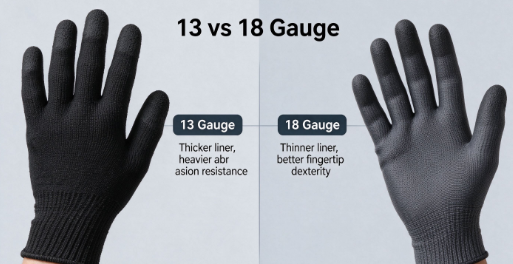
- High-performance polyethylene (HPPE) blended with special mineral fillers: This is the most mainstream commercial formulation. The filled HPPE matrix creates a dense, low-flow structure that resists needle tip propagation, while maintaining light weight and good tactile dexterity. This grade suits long-shift sorting tasks where workers need to maintain precise finger control.
- Aramid/Kevlar blends: Aramid fibers deliver stable cut and thermal resistance alongside needle resistance. The material will not melt when exposed to incidental hot surfaces, making it suitable for environments combining needle sharps and hot waste fractions. The trade-off is increased fabric thickness and reduced fingertip sensitivity compared to filled HPPE variants.
- Composite layered fabrics: Multi-layer constructions integrate flexible anti-puncture barrier films between knit substrate layers. The stacked barrier blocks needle tips effectively. This design delivers higher needle resistance grade, but the layered structure tends to reduce flexibility and tactile feedback.
- Reinforced fingertip or palm inserts: Partial reinforcement design only adds anti-needle composite inserts on high-risk contact zones instead of full-hand coverage. This optimizes cost, keeps the rest of the glove flexible, and works well for roles where needle contact concentrates on fingertips.
4. The Difference Between Needle-Stick Resistant Gloves and Cut-Proof Gloves
- Primary hazard focus
Needle-stick resistant gloves are developed for thin, pinpoint hazards including hypodermic needles and fine gauge wire. Cut-proof gloves target slicing hazards such as utility blades, sharp sheet metal edges and broken glass.
- Protection mechanism
Needle-stick resistant gloves depend on dense filled fiber matrix or internal barrier films to stop a sharp point from pushing through the fabric. Cut-proof gloves use tightly woven high-strength fiber networks to catch blades and dissipate slicing force.
- Relevant testing standards
Needle-stick performance follows ISO 23907. Cut resistance is graded under EN 388 cut levels or ANSI/ISEA 105 cut standards.
- performance limitations
A glove certified for needle-stick resistance may not offer high cut protection against sharp blades. Standard cut-resistant knit gloves have open gaps between woven fibers, and thin needles can easily slide through these gaps.
- Suitable working scenarios
Needle-stick resistant gloves fit medical waste handling, veterinary needle work and sharps sorting. Cut-proof gloves are preferred for metal fabrication, component assembly and glass processing.
5. Usage & Replacement Rules
Pre-use inspection forms the first line of control. Even microscopic pinholes that are invisible to casual visual check will compromise can implement routine glove inspection protocols before every task cycle.
Avoid excessive stretching of the glove material during donning and use. Stretching widens interstitial gaps in knit structures and can compromise the integrity of internal barrier films, directly lowering needle penetration performance. Immediate replacement is mandatory once any snags, surface thinning, visible tears or pinholes are identified. Degradation from abrasion gradually weakens the anti-needle layer over service time, even without obvious holes.
Cleaning and laundering must strictly follow manufacturer instructions. Strong alkaline detergents, blench and high-temperature tumble drying will degrade the functional fillers and composite films inside the glove, permanently reducing ISO 23907 rated performance.
6. Conclusion
When workplace hazards centre on discarded syringes and fine sharps, ISO 23907 certified needle-stick resistant gloves should be selected, rather than relying solely on general puncture or cut ratings. Balance the required penetration resistance level, fingertip dexterity and durability according to your actual workflow. Establish clear inspection and replacement schedules to keep consistent PPE protection for exposed staff.