Gauge refers to the number of knitting needles per inch across the knitting machine, which defines the stitch density of knitted glove liners. 13 gauge and 18 gauge are the dominant knitting specifications for cut-resistant, general-purpose and coated work gloves. Many purchasers confuse gauge rating with protection level. In fact, gauge controls the physical structure of the knit liner, while cut resistance is determined by fiber composition, yarn construction and coating material. The needle count directly impacts liner thickness, tactile sensitivity, breathability, abrasion performance and overall hand fit.
1. What is 13 Gauge Glove Liner?
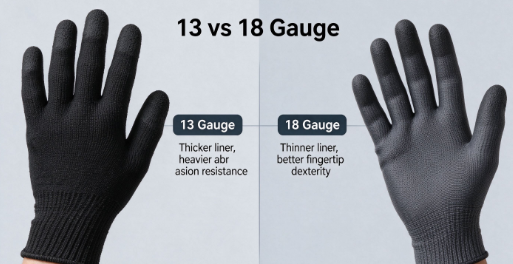
13 gauge uses a knitting machine with 13 needles per inch. It runs thicker staple or filament yarns to form a more open, robust knit structure.
- The liner has higher material mass per unit area, delivering stronger abrasion resistance against rough surfaces, sharp burrs and heavy friction.
- It provides better impact buffering and tear resistance for heavy-duty handling.
- The thicker knit creates a slightly bulkier hand feel, which reduces fingertip tactile feedback.
- It is compatible with latex, nitrile, PU and TPR coatings for enhanced grip and liquid resistance.
- Typical applications: metal fabrication, construction, warehouse loading, scrap handling, heavy machinery assembly.
2. What is 18 Gauge Glove Liner?
18 gauge uses a knitting machine with 18 needles per inch. Fine-count yarns are used to produce a compact, thin knit structure with higher stitch density.
- The liner is lightweight and low-profile, achieving a sung, second-skin fit.
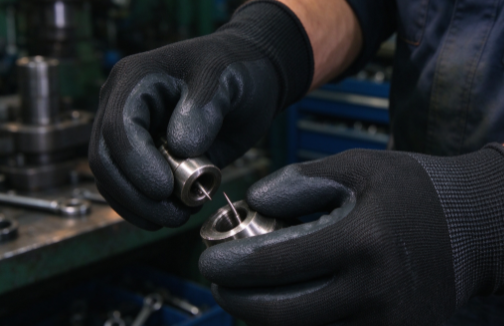
- It preserves excellent fingertip dexterity and tactile sensitivity, so workers can pick small fasteners, operate small tools and read tin y labels easily.
- Higher stitch density improves liner uniformity, which supports consistent coating coverage on the glove surface.
- It has less material volume, so abrasion resistance is lower than 13 gauge under the same fiber material.
- Typical applications: electronics assembly, precision component fitting, quality inspection, small parts sorting, fine packaging work.
3. Core Technical Differences Between 13 Gauge and 18 Gauge
- Knitting density: 13 gauge=fewer stitches per inch; 18 gauge=more stitches per inch.
- Liner thickness & weight: 13 gauge is heavier and thicker; 18 gauge is thin and lightweight.
- Dexterity & tactile performance: 18 gauge outperforms 13 gauge for fine, precise operations.
- Abrasion resistance: With identical fiber material and coating, 13 gauge offers better wear life.
- Breathability: 18 gauge is usually cooler for long shifts because of its slim structure.
- Coating compatibility: Both work with common coatings, but 18 gauge delivers smoother coating finish.
- Critical reminder: Gauge is not a cut rating. A 18 gauge HPPE liner can reach high cut levels, while a 13 gauge polyester liner offers almost no cut protection. Never judge cut performance by gauge number alone.
4. Practical Selection Rules for Buyers
- Select 13 gauge when your primary hazard is rough surfaces, heavy friction and frequent contact with sharp burrs. Prioritize service life over ultra-fine touch.
- Select 18 gauge when the job requires precise finger movement, small part manipulation or continuous delicate handling.
- If you need both high cut resistance and good dexterity, choose 18 gauge liners made with HPPE or aramid fiber.
- If workers need heavy abrasion protection plus basic cut resistance, pick 13 gauge high-performance fiber liners.
- Always match the gauge with your hazard assessment, instead of picking a higher gauge number blindly.