1. Introduction
Branded logos on protective and functional gloves serve two core purposes: brand identification and product traceability. For PPE suppliers, industrial buyers and promotional merchandise dealers, logo decoration is far more than a simple print. Different decoration processes interact differently with glove substrates—including nitrile dip coating, PU coating, knitted polyester, cowhide split leather and synthetic suede.
A logo that looks crisp on a showroom sample can fail quickly in field use: ink cracks from repeated flexing, transfers lift under solvent contact, or bulky embroidery interferes with grip sensitivity. This guide breaks down the technical principles, performance thresholds and application boundaries of mainstream glove logo crafts. It helps you make a data-backed decision instead of relying only on visual effect.
2. Main Glove Logo Decoration Processes
Screen printing
Screen printing transfer pigment ink through a woven mesh stencil. The open mesh areas allow ink deposit onto the glove surface. Most glove screen inks are formulated with elastic binders to match the stretch rate of knot substrates.
Pros: Low unit cost for mass production, good resistance to dry abrasion, stable color fastness, compatible with most coated and uncoated glove surfaces.
Cons: Resolution is limited by mesh count. Fine lines thinner than 0.8 mm are hard to reproduce. Each separate color requires an individual screen, so multi-color designs raise setup cost. Gradient effects are difficult to achieve.
Best for: Simple 1-3 color logos on knit liner gloves, canvas gloves and full-grain leather work gloves, especially orders above 5000 pairs.
Heat Transfer & DTF
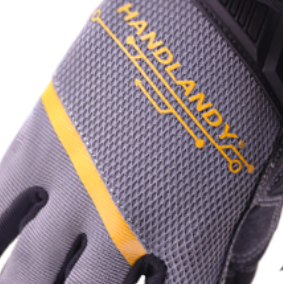
Traditional heat transfer uses pre-printed vinyl films. DTF (Direct-to-Film) is an updated transfer technology: patterns are printed onto PET film with pigment ink and adhesive powder, then hot pressed onto the gloves.
Pros: High printing resolution, supports photo-level gradients and small text, very low minimum order quantity, fast sampling turnaround.
Cons: The adhesive layer has limited resistance to oil, grease, and common industrial solvents. Under continuous bending and friction, edge delamination is a common failure mode. Stretch performance depends heavily on the transfer film elasticity.
Best for: Promotional event gloves, small batch custom orders, short-run branded merchandise that will not face heavy mechanical wear.
Embroidery
Embroidery forms logos by stitching polyester or rayon thread into the glove fabric. For PPE gloves, high-tenacity polyester thread is preferred for better color fastness and tear resistance.
Pros: Outstanding wash durability and abrasion resistance, premium tactile texture, will not dissolve by mild oil.
Cons: Stitching creates raised thickness. When placed on the palm or finger bending zones, it reduced dexterity and grip contact area. It cannot stitch firmly on smooth nitrile/PU coated surfaces, as the coating has no fabric fiber for thread anchoring.
Best for: Thick leather work gloves, insulated winter gloves, logos positioned on the back of hand or wrist cuff.
Silicone/TPU Raised Logo
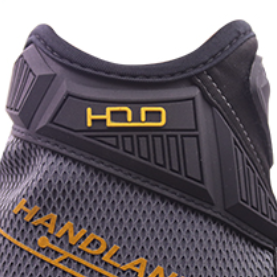
Silicone and TPU logos are 3D molded marks. Liquid silicone is cured by heat. TPU logos are mostly hot-pressed molded labels. Both materials retain high elongation after forming.
Pros: Excellent elasticity matching stretchable glove liners, strong oil and abrasion resistance, non-peeling structure, and extra slight anti-slip function.
Cons: Custom mold charge is required for new logo shapes. Curing and molding cycles extend production lead time. Fine tiny details are hard to mold cleanly.
Best for: Mechanical gloves, anti-slip handling gloves, high-performance sports and safety gloves.
Sublimation
Sublimation uses disperse dyes. At around 180-200℃, solid dye turns directly into gas and penetrates into polyester fiber molecules, instead of sitting on the fabric surface.
Pros: Zero raised layer, no texture change on the glove surface, unlimited color gradients, will not peel or crack with stretching.
Cons: Chemical bonding only happens on polyester fibers. It cannot dye cotton, leather, nitrile or PU. On dark polyester base fabric, dye colors are muted and low saturation.
Best for: Light-colored polyester knitted liner gloves, outdoor and lightweight fashion gloves.
Laser Engraving
Laser engraving uses focused thermal energy to etch or discolor leather surfaces. It removes a thin top layer without adding any foreign ink or material.
Pros: Permanent marking, no extra layer, consistent effect after repeated use and cleaning.
Cons: Only works on natural leather, synthetic leather or coated fabrics may melt and produce ugly marks. The final color is limited to natural tan or dark burnt shade.
Best for: Full-grain cowhide work gloves, premium leather golf gloves.
3. Key Factors to Pick the Right Process
Before confirming your logo craft, evaluate these technical criteria together with your supplier:
- Glove substrate compatiability: Nitrile and PU dipped surfaces have low surface energy. Embroidery and sublimation are not suitable. Screen print or silicone transfer are the safer choices.
- Logo geometry requirement: Lines thinner than 0.8 mm and complex gradient rule out screen printing and silicone molding: DTF or sublimation are better picks.
- End-use exposure: If gloves contact mineral oil, cutting fluid or cleaning solvents, avoid standard heat transfer. Silicone or solvent-resistant screen ink is recommended.
- Stretch specification: Knit gloves usually have 100%-150% stretch rate. Rigid decoration will crack under repeated extension.
- Ergonomic restriction: Any raised logo on palm or fingertip areas will compromise grip and touch sensitivity. Reserve logo placement for the back-of-hand or cuff region.
- Order economics: Screen printing has high fixed screen cost but low piece price for bulk. DTF has nearly zero setup cost but higher unit price for large volumes.
4. Conclusion
Logo decoration for safety and functional gloves is not only a branding step but an integral part of glove performance design. Every decoration methods has clear material limits and mechanical trade-offs that directly affect the glove’s core function: flexibility, grip, wear resistance and chemical resistance.
When you select a logo process, prioritize matching the craft to the glove’s base material and real working conditions first, rather than only chasing visual effects. Work closely with your manufacturer to specify required performance tests, such as abrasion resistance, oil resistance and wash stability. A well-chosen logo stays intact through daily heavy use, keeps the glove’s original protective function, and delivers reliable brand value without sacrificing hand protection.