1. Introduction
Cold working environment including cold storage warehouses, winter outdoor construction, refrigeration logistics and frozen goods handling expose workers to continuous low-temperature hazards. Long-term cold air exposure or frequent direct contact with frozen metal and goods often leads to hand numbness, reduced operational dexterity, decreased work efficiency, and even skin frostbite.
Most ordinary warm gloves only rely on thickness for basic warmth, without standardized performance testing, resulting in insufficient and unstable cold resistance in industrial scenarios. EN 511 is the official European PPE standard specially designed for cold-protective gloves. It formulates unified laboratory test rules, accurate thermal resistance indicators and clear level ratings, helping enterprises and workers select qualified, task-matching cold-proof gloves and avoid occupational cold injury risks.
2. What is the EN 511 Standard?
EN 511 is a harmonized European safety standard that specifies complete test methods and performance requirements for cold protective gloves. It targets two core industrial cold hazards: convective cold damage caused by low-temperature flowing air, and contact cold damage caused by direct touch with ultra-cold solid surfaces. This standard can accurately grade glove protection performance for working environment as low as -50℃.
Different from vague commercial claims like “super warm gloves”, EN 511 certification is fully based on standardized laboratory tests with quantifiable thermal resistance data. It serves as an authoritative and credible verification basis for industrial cold-proof glove performance, and is widely adopted in European industrial manufacturing, cold chain logistics and commercial refrigeration industries.

3. Three Core EN 511 Performance Parameters
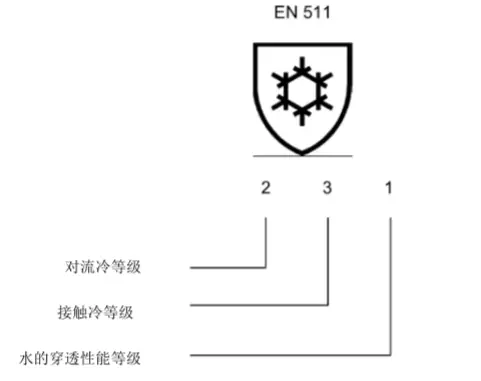
All EN 511 certified gloves are marked with a standard 3 digit coding format. The three digits independently represent convective cold resistance, contact cold resistance, and water penetration resistance respectively. Higher values mean stronger protective performance. Each parameter has fixed test methods, professional thermal resistance indicators and clear level standards.
3.1 Convective Cold Resistance (Level 0-4)
Convective cold resistance evaluates a glove’s ability to block cold wind and low-temperature, reducing body heat loss from air convection. It is the core indicator for outdoor winter work and long-term cold storage indoor operation.
Official Test Standard: A heated dummy hand(maintained at 30~35℃) is placed in a -20℃ low-temperature wind chamber to test thermal insulation performance, measured by the ITR thermal insulation value.
- Level 0: No effective thermal insulation performance
- Level 1 (ITR 0.10~0.15): Light cold resistance, suitable for short-time outdoor work at around 5℃
- Level 2 (ITR 0.15~0.22): Moderate thermal insulation, applicable to general winter outdoor work at 0~5℃
- Level 3 (ITR 0.22~0.30): Excellent stable insulation, ideal for -5~-18℃ cold storage and winter construction sites (the most widely used industrial grade)
- Level 4 (ITR ≥0.30): Top-tier extreme cold insulation, designed for -18~-30℃ ultra-low temperature scenarios and long-hour cold environment operations
3.2 Contact Cold Resistance (Level 0-4)
Contact cold resistance assesses the glove’s isolation effect when hands directly touch frozen metal, trays and icy equipment. It prevents rapid cold conduction and local frostbite caused by direct contact with ultra-cold solids, which is critical for frozen goods sorting and metal equipment operation.
Official Test Standard: Tested and graded based on the thermal resistance value, reflecting the solid cold barrier capability of glove materials.
- Level 0: No cold isolation effect
- Level 1 (R 0.025~0.050): Basic isolation, suitable for short-time contact with slightly cold workpieces
- Level 2 (R 0.050~0.100): Moderate cold isolation, perfect for frequent frozen goods handling
- Level 3 (R 0.100~0.150): Superior isolation, applicable to long-time continuous contact with icy metal surfaces
- Level 4 (R≥0.150): Premium extreme cold isolation, for sustained contact with ultra-low temperature metal in frigid environments
3.3 Water Penetration Resistance (Level 0 or 1)
Water resistance is a decisive factor for stable cold protection in humid, frosty and snowy environments. Unlike the 0-4 grading of thermal indicators, this parameter only has two levels, verified by a 30-minute water immersion test.
- Level 0: Water penetrates the glove within 30 minutes of immersion. Moisture destroys the internal air insulation structure, resulting in a sharp drop in thermal insulation performance
- Level 1: No water penetration after 30-minute immersion. The glove maintains stable cold-proof performance even in wet and frosty working conditions
Standard Code Example: A glove marked with 231 mean Convective Cold Resistance Level 2, Contact Cold Resistance Level 3, and Water Penetration Resistance Level 1.
4. Common EN 511 Glove Misunderstandings
Most incorrect glove selections stem from intuitive misconceptions rather than actual performance data. The four most common misunderstandings are listed below:
- Thicker means warmer: Glove insulation performance depends on fiber air-locking structure and certified ITR thermal resistance value, not thickness. Bulky thick gloves often have low EN 511 levels and poor finger exterity.
- Fluffy appearance equals certified performance: Visual soft and fluffy texture cannot replace standardized EN 511 laboratory testing. Uncertified warm gloves usually fail to maintain insulation in continuous low-temperature environments.
- Indoor cold storage requires no waterproofing: Cold warehouses generate constant frost and water vapor. Damp gloves lose insulation rapidly and greatly increase frostbite risk.
- EN 511 performance is permanent: Fiber compression, dirt accumulation and material aging will damage the air insulation structure and reduce cold resistance, so regular glove replacement is necessary.
5. Conclusion
EN 511 standardized the evaluation system for cold-protective gloves, completely eliminating subjective and misleading commercial marketing of warm gloves. Its three core quantifiable parameters-convective cold resistance with ITR values, contact cold resistance grading—enable precise, scenario-based glove selection. Choosing genuine EN 511 certified gloves, especially dual-certified models paired with EN 388, effectively prevent occupational frostbite, maintains working dexterity, and achieves standardized, reliable long-term hand safety protection for all low-temperature industrial operation.