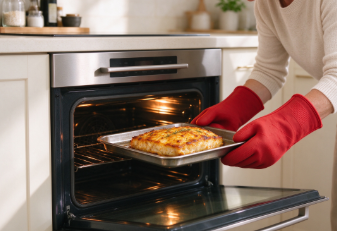
Most people think thicker oven gloves are always safer. But many thick cotton gloves still let heat through and cause burns. Effective heat protection is not about bulk—it is about material science and how heat moves. This article breaks down the basic physics of oven burns, explains how insulation materials work, and helps you choose gloves based on real technical logic.
1. The Three pathways of Heat Transfer
Burns happen when heat reaches your skin. In kitchen and oven use, heat travels in three separate ways. Good oven gloves must block all three, not just direct contact heat.
- Conduction: Heat moves through direct touch with a hot solid object, such as a metal baking tray or oven rack.
- Convection: Hot air flows out of the oven and carries heat onto your hands and wrists.
- Radiation: Hot oven walls and heating elements send out invisible infrared heat that warms your skin from a short distance.
2. How Oven Gloves Block Heat: Core Insulation Mechanisms
The heat protection performance of oven gloves is not derived from material thickness or weight, but from engineered structures that specifically target the three heat transfer pathways outlined above. High-performance gloves typically combine all three mechanisms to deliver comprehensive thermal defense.
2.1 Static Air Entrapment- Conductive Heat Resistance
Static, non-moving air is inherently an extremely poor thermal conductor, with far lower heat conductivity than most solid materials. The core principle of fibrous glove insulation is to lock enormous volumes of static air into micro-sized closed cavities formed by interlaced fiber structure.
These tiny, uniform air pockets eliminate large-scale air circulation inside the material, limiting conductive heat transfer to the micro-scale. Insulation efficiency directly correlates with the quantity and stability of these cavities: finer fibers create exponentially more air pockets per unit weight. This is the reason high-performance microfiber gloves can outperform bulky thick cotton gloves at a fraction of the thickness.
2.2 Fiber Network Flow Barrier- Convective Heat Attenuation
Convective heat transfer occurs when flowing hot air carries heat through the glove material. A dense, multi-layer fiber matrix acts as a porous flow barrier that disrupts and dissipates hot air streams.
As hot air penetrates the glove structure, the staggered fiber network splits continuous airflow into countless micro-scale eddies, reducing flow velocity and heat-carrying capacity. This prevents bulk hot air from reaching the inner surface of the glove, which is especially critical when reaching into a heated oven cavity with strong rising convection currents.
2.3 Infrared Radiation Shielding- Radiant Heat Blocking
High-temperature oven walls and heating elements emit intense infrared(IR) radiant heat, which transfers heat without direct contact or air flow. Oven gloves address radiant heat through two primary engineering approaches.
- Reflective shielding: Metallized coatings or thin reflective film layers reflect most incoming IR radiation back toward the heat source, before it can be absorbed and converted into conductive heat.
- Absorptive attenuation: High-density fiber layers absorb and gradually dissipate radiant energy across the material thickness, reducing the total heat flux that reaches the skin.
Radiant heat is often the overlooked cause of brief-contact burns; targeted shielding mechanisms greatly extend safe handling time near high-temperature surfaces.
3. Common Oven Glove Materials
Different materials rely on district insulation mechanisms and deliver varying levels of thermal protection. The table below summarizes typical short-contact performance for mainstream oven glove materials.
| Material | Core Insulation Mechanism | Typical Short-Term Heat Resistance | Key Advantages | Main Limitation |
|---|---|---|---|---|
| Terry cotton | Traps air in fluffy fiber loops | ~200°C | Low cost, soft, flexible | Loses protection when wet; heat seeps through over time |
| Silicone | Blocks direct conductive heat | ~250°C | Waterproof, easy to clean | Weak against radiant heat; conducts heat with long contact |
| Aramid fiber | High-heat stable fiber air-locking | ~350°C+ | Extreme heat resistance, durable | Higher cost; stiffer feel |
| Neoprene foam | Closed-cell foam traps air | ~200°C | Waterproof, cushioned | Breaks down at very high temperatures |
| Microfiber lining | Ultra-fine fiber micro air pockets | ~250–300°C | Lightweight, thin but warm | Can be damaged by sharp metal edges |
4. Hidden Factors That Change Real Protection Effect
- Moisture: Wet gloves conduct heat much faster. Never use damp or freshly washed oven gloves.
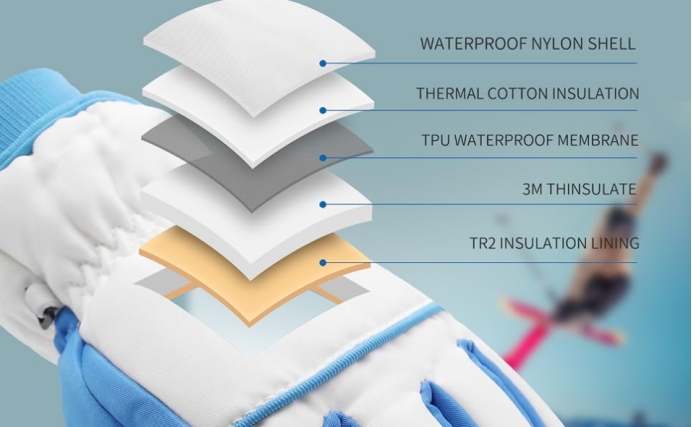
- Construction: Quilted and layered designs hold air better than flat singer-layer material.
- Wear and aging: Compressed or worn fibers lose their air pockets. Old flattened gloves often much less protection.
- Contact time: No glove blocks heat forever. All ratings are for short-duration contact.
5. How to Choose and Use Oven Gloves
Use these simple, science-backed rules for better kitchen safety.
- Match the heat rating to your highest oven temperature and typical tasks.
- Choose layered construction over single thick material for better balance of protection and finger movement.
- Replace gloves when they become flat, stiff, stained or torn.
- Always make sure gloves are fully dry before use.
Oven glove heat protection is not determined by material thickness, but by engineered structures that specifically interrupt the three pathways of heat transfer: conduction, convection and radiation. Static air entrapment, fiber network flow barriers and radiant heat shielding work in combination to deliver reliable thermal defense, often in lighter, slimmer profiles than traditional bulky cotton gloves.
Understanding the science behind common insulation materials removes guesswork form glove selection. It allows users to match protection performance to their actual cooking temperatures and task types, instead of relying on the misleading assumption that thicker always means safer.