
In low-temperature industrial scenarios such as cold-storage logistics, outdoor winter construction and refrigeration maintenance, effective hand thermal protection is not only a matter of wearing comfort, but also a key component of occupational safety. Traditional glove insulation materials generally rely on increased thickness and fiber volume to trap heat, which creates a long-standing trade-off: bulky insulation severely limits finger dexterity and operational precision, while slim designs often fail to deliver sustained warmth. Worse still, sweat buildup during prolonged work accelerates conductive heat loss and raises the risk of cold injury.
As a benchmark microfiber thermal insulation technology developed by 3M, Thinsulate breaks this technical dilemma from the mechanism of heat transfer. It achieves high-efficiency thermal retention at minimal thickness and weight, while maintaining reliable moisture vapor permeability.It has been widely recognized as a premium insulation solution for high-performance cold-protective personal protective equipment(PPE) gloves.
1. What is 3M Thinsulate
Developed by 3M, Thinsulate is a high-efficiency thermal insulation material engineered from ultra-fine synthetic microfibers. Unlike conventional bulky insulation that relies on loose fiber volume, Thinsulate leverages micron-scale fiber structure to trap static air-the most effective natural thermal barrier-at extremely high density. It is widely deployed in outdoor apparel, cold-weather gear and industrial protective gloves, recognized for its industry-leading warmth-to-thickness ratio.
2. Core Technical Principle of 3M Thinsulate
The superior thermal performance of thinsulate stems from three complementary insulation mechanisms,covering all three major pathways of human heat loss: conduction, radiation and moisture-related cooling.
2.1 3D Fiber Air-Lock Conductive Insulation
Thinsulate is composed of 2-5 μm ultra-fine fibers interlaced into a three-dimensional network, creating billions of micro-scale closed air cavities. Static air trapped inside these cavities dramatically slows conductive heat transfer from the hand to the external environment.
Compared with standard 6-denier hollow chemical fibers, ultra-fine fibers produce an exponentially higher number of air cavities at identical weight. This gives Thinsulate significantly higher static air retention efficiency and better thermal performance per gram.
2.2 Micro-Scale Radiant Heat Barrier
Human body heat also dissipates in the form of infrared radiation. Thinsulate uses a blended fiber formulation of sub-10 μm microfibers and sub-15 μm fine fibers to increase overall fiber volume fraction. This dense fiber matrix forms a physical “radiation insulation shield” that reflects and blocks outgoing infrared thermal radiation. By reducing radiative heat loss, it further elevates total thermal retention efficiency beyond simple air-trapping insulation.
2.3 Duel-Directional Heat Retention & Moisture Vapor Transfer
Thinsulate operates as a dynamic thermal regulation system rather than a passive warm layer:
Inward thermal reflection: The fine fiber structure reflects body radiant heat back toward the skin, minimizing net heat loss.
Outward moisture conduction: The hydrophobic fiber surface repels liquid sweat while allowing water vapor to diffuse outward rapidly.
This two-way mechanism maintains continuous warmth without trapping perspiration, preventing clammy hands and post-sweat chilling during active work.
3. Key Technical Advantages
- High thermal efficiency: Delivers equivalent warmth at roughly one-third the thickness of traditional insulation materials.
- Controlled breathability: High moisture vapor transmission rate (MVTR) maintains dryness during sustained physical work.
- Structural durability: Resists compression, clumping and fiber migration over repeated use and laundering cycles.
- Safety and environmental compliance: Free of harmful substances, conforms to international PPE safety and environmental standards.
4. Application in Work Gloves
In industrial hand protection, Thinsulate delivers measurable practical improvements:
- It enables slimmer, more ergonomic glove profiles without sacrificing thermal protection, preserving finger dexterity and operational accuracy.
- By reducing sweat accumulation, it lowers slip risk inside the glove and improves all-shift comfort, supporting sustained work efficiency.
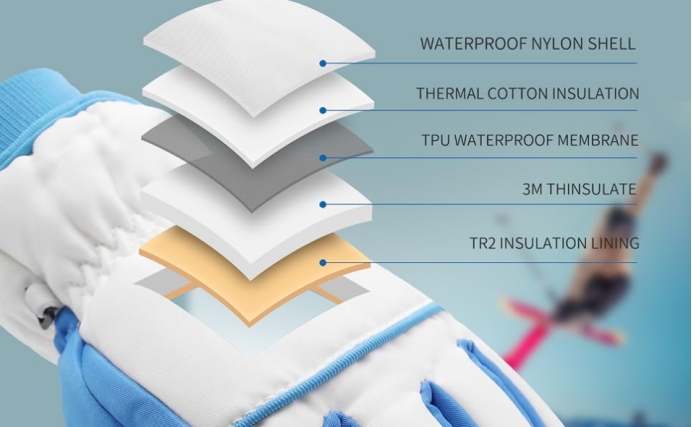
- It is compatible with common glove protective layers including leather, nitrile coating and water-resistant shells, and is widely specified for cold-storage logistics, outdoor construction, refrigeration operation and general low-temperature maintenance tasks.
5. Conclusion
3M Thinsulate is a mature, technically validated microfiber insulation system built on air-locking conduction resistance, infrared radiation shielding and dynamic moisture management. Its ability to combine lightweight construction, reliable warmth and breathable comfort resolves the long-standing trade-off in cold-protective glove design. By selecting the appropriate Thinsulate grade matched to working temperature and task requirements, users can achieve standardized, efficient and ergonomically sound hand thermal protection in low-temperature industrial scenarios.